DITTO: Dexterous Interface
for Transparent TeleOperation
* Equal contribution † Equal advising
1
2
* Equal contribution † Equal advising
Collecting data for manipulation with high-DOF hands is challenging, as interfaces must capture rich hand motion while rendering the contact interactions essential for precise manipulation. Existing data collection approaches face a trade-off: teleoperation ensures deployment consistency but lacks force feedback, while handheld (in-the-wild) systems provide natural force transparency but introduce a visual embodiment gap at deployment. We present DITTO, a Dexterous Interface for Transparent TeleOperation, which resolves this through the anatomically informed co-design of a dexterous 7-DOF robotic hand and a kinematically equivalent motorized exoskeleton. A 1-to-1 actuator mapping between the exoskeleton and robotic hand enables handheld (in-the-wild) data collection and bilateral teleoperation with joint-level force feedback unified in a single platform. We demonstrate that the DITTO exoskeleton spans the operator's natural index-to-thumb workspace, and showcase DITTO's dexterous capabilities via learned policies on contact-rich tasks.
DITTO's leader-follower 1:1 joint correspondence enables joint-level force feedback.
DITTO enables highly dexterous teleoperation, leveraging coordinated index/thumb control.
DITTO supports both:
Policies trained on data collected via DITTO teleoperation perform contact-rich tasks relying on the hand's intrinsic degrees of freedom.
Success rate over 20 trials per stage, for Diffusion Policies (Transformer) trained on DITTO teleoperation data.
In a user study with 8 participants, DITTO's human-aligned kinematics and force feedback led to faster manipulation and gentler contact forces.
Flip a mahjong tile as many times as possible in 60 s, testing speed during coordinated index–thumb motion.
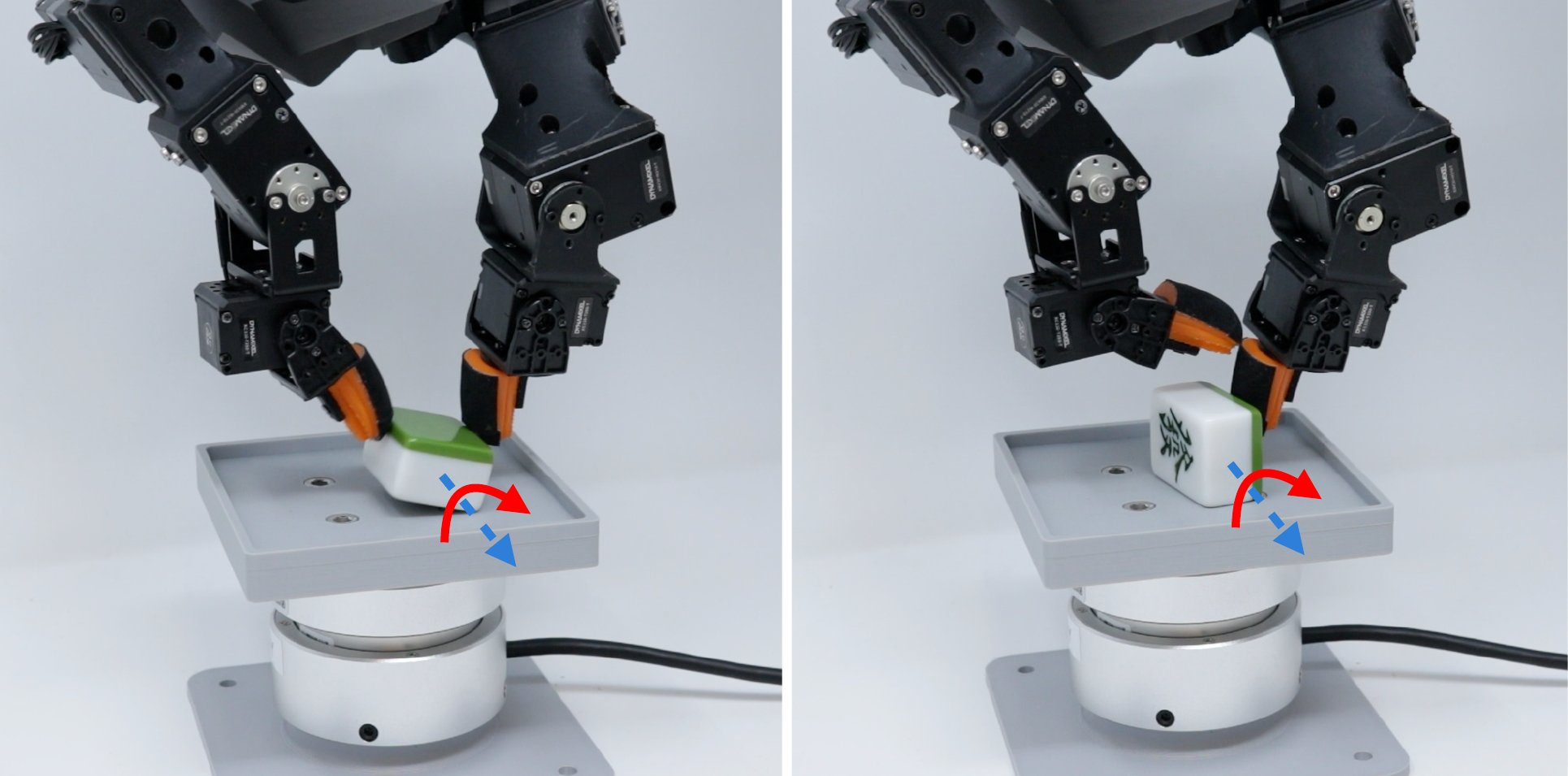
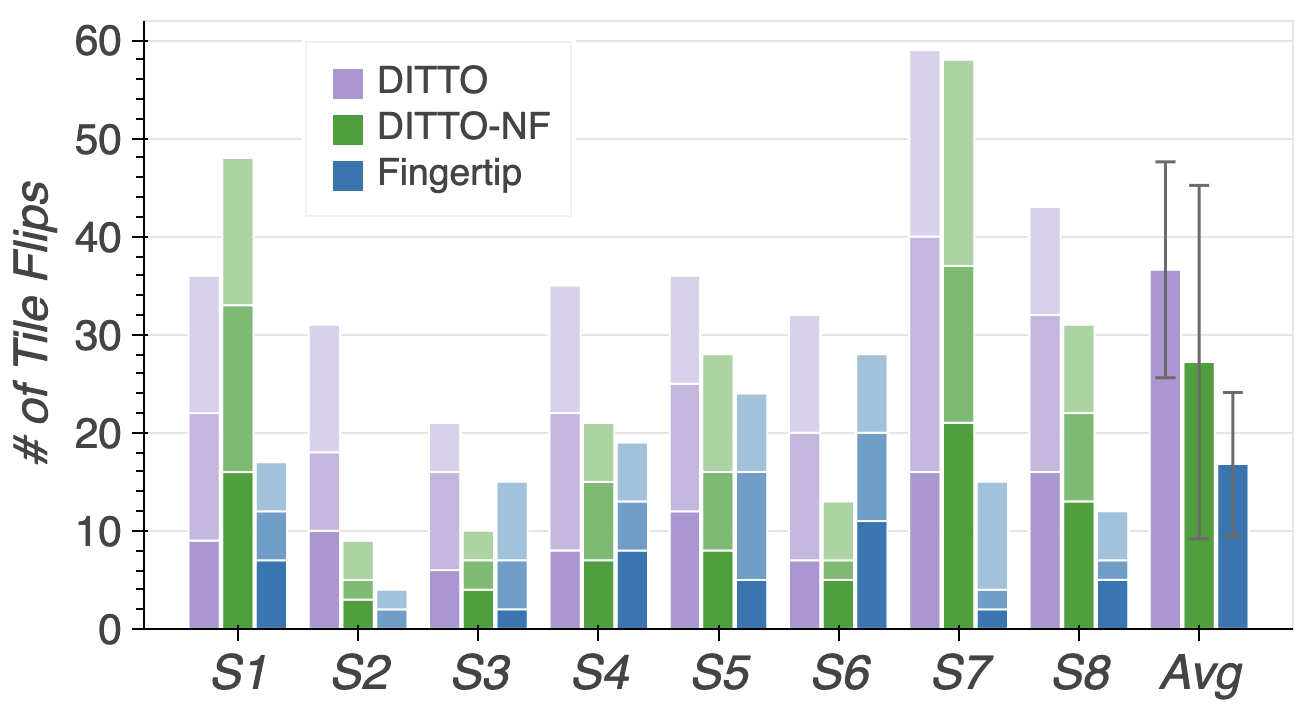
Every participant flipped the most tiles with the DITTO exoskeleton, and all but one did best with force feedback on. DITTO beats Fingertip (p ≤ 0.023, one-sided permutation test). Flips are each participant's total over the three trials; bars show the mean ± std across the 8 participants.
Turn a ratchet three full revolutions as fast as possible (instrumented with a force-torque sensor).
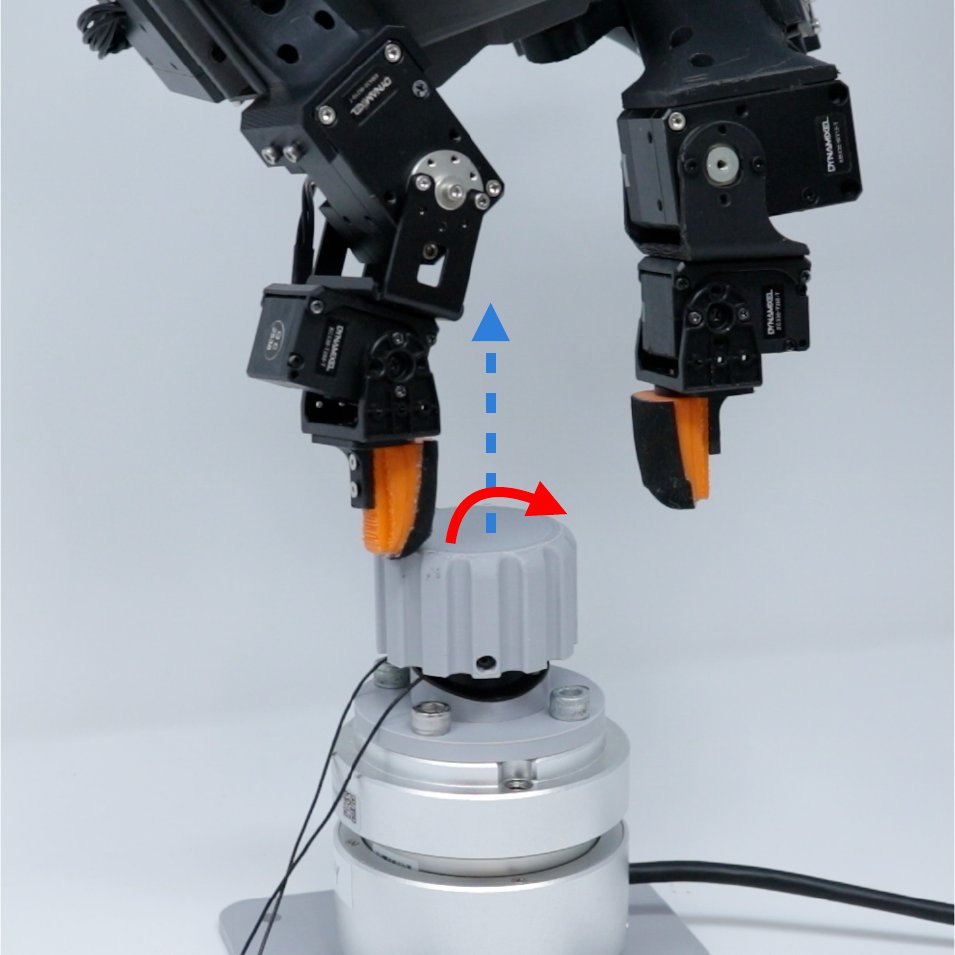
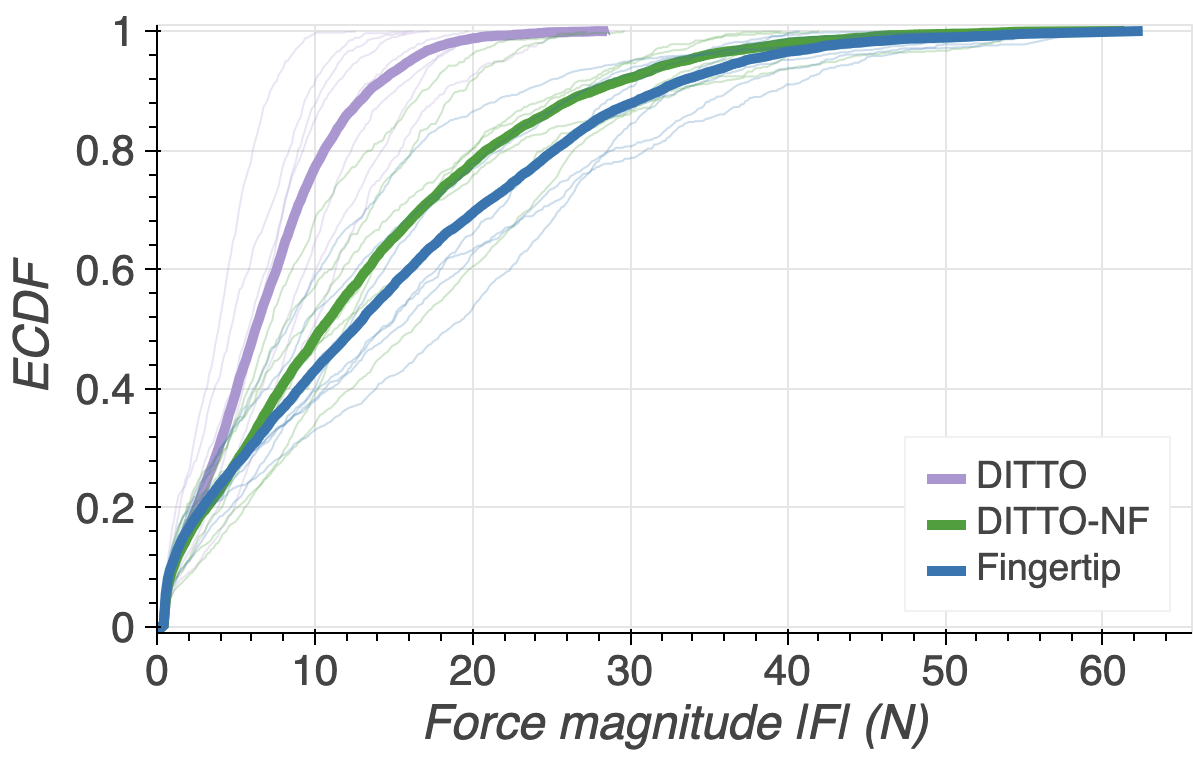
DITTO gave every participant their lowest average force. Without force feedback, participants turned the ratchet slightly faster, but with nearly twice the force. DITTO beats DITTO-NF on both force metrics (p = 0.012) and Fingertip on every metric (p ≤ 0.023), by one-sided permutation tests. Bars show the mean ± std across the 8 participants.